For the Record
The Life, Death, and Resurgence of the Vinyl Record
Andrew Rogolino
William Paterson University
COMM 4453-0
Contents
Abstract………………………………………………….…………………………......................3
Introduction & Significance…………………………….……………………………………4,5
History of the Vinyl Record…………………………….……………………………………5,6,7
Height, Decline, and Revival…………………………….……………………………………7,8,9
How to Start a Collection of Your Own……………………………………………………9,10,11
Conclusion…………………………………………………………………………………….11
References……………………………………………………………………………………13,14
Abstract
In this paper, you will discover how vinyl records became a concurrent necessary artifact for historical nature to revitalize musical mainstay. First, you have to realize that vinyl records were not just a rite of passage for music lovers, but they were transcendent means of communicating to the masses. The format shaped modern and past history to give real-life audible voices to the establishing figures. Historians have learned countless aspects, stories, moments from those voices in the grooves. Next, you will read about how that format began to love, lose, then regain touch with their listeners. The vinyl record was losing their average listener in fault for a cheaper, yet higher quality format. The compact disc. Vinyl was gradually becoming deprived each year, so much that by the end of the 1990s some labels were strictly doing the production of compact discs and turning their heads towards record plants altogether. Later in the early 2000s, vinyl saw an unexpected resurgence. The industry saw a huge revival, a complete 180 from the ever so declining format. With the help of the nostalgia mindset of young and older generations, the internet, and record stores who stuck around, vinyl welcomes itself back to the mainstream. Finally, I will speak about how one can start collecting records of their own. What to look for, a site to use, different types of conditions, and the entire arc of beginning a collection. From the bargain bin to the record platter.
Introduction & Significance
When you hold a piece of circular, polyvinyl chloride, where does your mind go? To a melophile (a common music listener), it is a hunk of junk, to an audiophile (a high fidelity nut), it is a source of love locked in the grooves. How music is played shapes an audio listener. The way a melophile uses music as background noise. Skipping a song to capture the mood. Whereas an audiophile takes time into account for the timbres deep in the mix. Listening to a full album to capture the essence of the artist’s emotion to match the element of the mood of the room. The vinyl record is important for every audiophile out there. They enjoy that sweet sound of the crackle when the needle runs out on the deadwax on side A. The overzealousness of excitement that goes into even finding the mint condition in the original seal for their favorite album of all time makes a collector go wild, “as philatelists desire mint stamps, vinyl collectors highly value the material "virginity" of records.” (Hosokawa, S., & Matsuoka, H.) The true importance of the vinyl record is community efforts and material possessions. Community efforts mean supporting small businesses. Shopping at record stores as opposed to bigger chains, such as Amazon, actually helps create jobs that are in demand and produces more tourism. Yes, even buying from a local record store can help promote tourism. Smaller businesses tend to have a social media page and/or some kind of web presence. On those sites, they always have a review and location setting, by outpouring support from their customers’ reviews can generate buzz for a town and the local record store.
As humans evolve and progress in the future, we are drawn towards what sets us apart from society. Individualism has been in such high demand in recent years. (Santos, H. C., Varnum, M. E., & Grossmann, I.) People hold onto their material possessions with the closest touch. It is almost like a hobby to hold onto these MP. At times, people even go forth to create entire social media pages to express and share their deep appreciation and love for their MP. With a quick scan of recent social media trends, some of the trendier items that we have seen in recent years have been customized shoes, 90s apparel, and thrift store findings. In the vinyl community, sacred first presses, promotion copies, and test pressings are all known covenant items to collect. Finding an album that turns into an evolving collection can be identified as material possessions. Music collecting aligns with success in findings and joy in long-term amusement. Having a record collection showcases your gratitude for social natures or known as being a cultural consumer and “‘affords the crystallization of sense of self with a history stretching back in time.’” (Sinclair, G., & Tinson, J.)
History of the Vinyl Record
Way before the format found its way spinning in the 1980s in super malls across the country, an obscure Euro disc jockey’s turntable, or the flooding of your local thrift store, recorded audio was created in Paris, France by Edouard-Leon Scott in 1857. What Scott invented in fact, was a piece of smoke-blackened paper or glass, that captures grooves or phonautograms. For the playback ability, the paper or glass had to be lined with a pig bristle or light stylus and connected to a funnel or a piece of flexible parchment paper. In April 1860, Scott recorded the first-ever sound. An extract from the French folk song "Au Clair de la Lune.” (Feaster, P.) 3 years later, in 1877, as France was celebrating their greatest invention, the United States was brewing up their type of invention. The well-known inventor and businessman, Thomas Edison was creating wax cylinders. The design was very similar to Scott’s, but Edison’s cylinders were made out of metal with tin foil wrapped around it. What made his device unique is the record and playback option. The vibration from the speaking into the mouthpiece would create deep grooves into the cylinders. His first recorded sound was the nursery rhyme “Mary had a Little Lamb.” Edison’s assistants Charles Batchelor and James Adams were testing out a new type of format; from an earlier sketch of Edison’s idea. The new format was made into a plate or later called discs. (National Park Service.) This format could be placed on the platter on and off countless times without being ruined. This format was accompanied by the graphmore. A stocky machine that ran off a motor to enforce and control speed and playback. The machine had an attached permanent conical diamond stylus for which only his Edison Disc Records could be played on. After Edison successfully cracked this idea, he began selling mass productions of these discs to consumers. (DeGraaf, L.) Big bands, artists, and musicians began recording songs and full-length albums onto these records. The plant that made the disc also held distribution rights; this label was called Edison Records. (Gitelman, L.)
In 1887, a German immigrant named Emile Berliner was granted a patent for his invention, the gramophone. (Smart, J. R.) After many trials and errors with the original sketch from Edison, Berliner finally found his unique way. He employed the usage of zinc into his discs. Then washed them in an acid bath. Unlike Edison’s invention, Berliner’s device needed two systems for playback, one for each process. He even gave the term "gramophone" in his ads. (Smart, J. R.) However, zinc was hard to reproduce. He tried sealing wax and plaster, but no success there. Subsequently, he did discover the substance celluloid was easily attainable. But shortly withdrawal since it could not stand repeated playability, due to the pressure from the steel tonearms. These discs have a very short circulation and are difficult to come by. Following scrapping this idea, he turned to rubber as a source for his discs. He brought this invention to his homeland for scientific methodology. After the approval, he sold a small run of celluloid discs and rubber discs to the England market as a kids’ toy. In 1895, the record disc saw its first sight of cataloging. Block numbering that held catalog order was appearing on his latest batch. The reason for the cataloging was to set apart the artists or bands from one to another. Each recording artist/group had their separate number, whereas represses or remakes were given a letter suffix. (Smart, J. R.) Two years later, he grew tiresome of gramophone assembling. By this time, the gramophone industry had a life of its own. He decided to sell off his company and royalties and began his next invention, the helicopter.
What succeeded Berliner’s record company changed the format once again. Radio Corporation of America bought out the world-renowned phonographs and phonograph records maker, Victor Talking Machine Company in 1929. Together, they came in the “Nipper Building” in Camden, New Jersey, and formed the RCA Victor Company. (Levins, H.) Eldridge Johnson, the corporate predecessor of RCA Records, made recorded music feasible for the masses. In 1931, RCA Victor was the first company to measure and track the speed of a record’s exact revolutions per minute (rpm.) Which was 33 1/3, and so RCA Victor massively produced records that matched the speed. (Osborne, R.) While World War II was in the forefront, when vinyl material supplies were in demand, some of the 78-speed records were pressed onto polyvinyl chloride. (The Vintage Record.) In the '50-'60’s, this material became stranded for all pressing plants.
The competitive edge for record plants was starting to take site quickly. By the end of the war, Columbia Records was neck to neck with RCA Victor. Columbia pushed the advantage with rpm. They found that different formats were tracked at different speeds. 45 rpm albums, 7”s or “singles,” being the smallest of the three common formats, were becoming increasingly popular with the jukebox era. (Osborne, R.) The A-side was intended to be was the hit song off the album and the B side was a follow-up song, usually found also on the B side of the album. Sometimes a cover song was found on the B side, for the recording artist, it was to pay homage to their beloved artists. (Osborne, R.) Later formats found their light, those being 12” and 10”. The reason they are called 7”, 12”, and 10” is because of the size of their jacket they came in. 10” and 12” formats played at normal 33 rpm.
Height, Decline, and Revival
Vinyl was welcomed at every house at its peak. Each household had various audiophiles. Music was being spun all over the place also. At home, events, clubs, and everywhere in between. Brands were even using vinyl as a commodity for promotional items. McDonald’s hosted a big-money contest using 33 1/3 flexi-disc to advertise their menu and products. (Blevins, J.) Their scheme was timely and effective, for it captured the musical period and got an overwhelming response. It was not till 2018 that the winning record was found, and the prize was awarded. Vinyl was for certain the format medium for the better half of the '80s.
Around the same time, physicist and inventor James Russell created his type of disc. However, his disc was optical and digital as opposed to analog and made out of wax. This disc could store up to 90 minutes of audio; 10 times greater than vinyl, be reproduced and replayed without being damaged, could be directly touched without ruining the audio, way more affordable to produce and purchase, and storage was lighter and seamless to move. Originally in 1970, the compact disc (CD) flopped and did not have sales, then 5 years later, Japanese global multimedia giant Sony examined his studies and decided to authorize his product. Another 5 years after that, Sony started to manufacture his invention (Müller, A., & Schönhart, S.) On October 1st, 1982 in Japan, the first CD player was released, and the name was called the “Sony CDP-101” and retailed for $625. That first CD released was Billy Joel’s 1978 52nd Street. Contrary to popular belief, Time magazine mentioned that album was not the first album tested on the compact disc. The first one was German composer Richard Strauss's piece An Alpine Symphony composed by Herbert von Karajan conducting the Berlin Philharmonic. The first CD assembled was a batch of ABBA’s The Visitors. (Giles, J.) By the end of the 80s, the compact disc had become the new, preferred format. To be exact, 1988 was when the physical music industry made its most significant shift. CD sales beat vinyl. The sales dropped 33%, bringing down the market to 15%. While CD saw a jump to 31%. On April 2, of that year, on the Billboard 200, all the songs were released on CD (Plasketes, G.) By the end of the same year, vinyl plants reduced almost 80% (341 to 72 million) of their units. At the time same, CDs' production was 0 in 1978 to 149.7 million in 1988 (Plasketes, G.) Music labels were dropping record plants. Some major plants were even closing their doors. CDs were filling the record store racks and shelves. The vinyl record was surely dead.
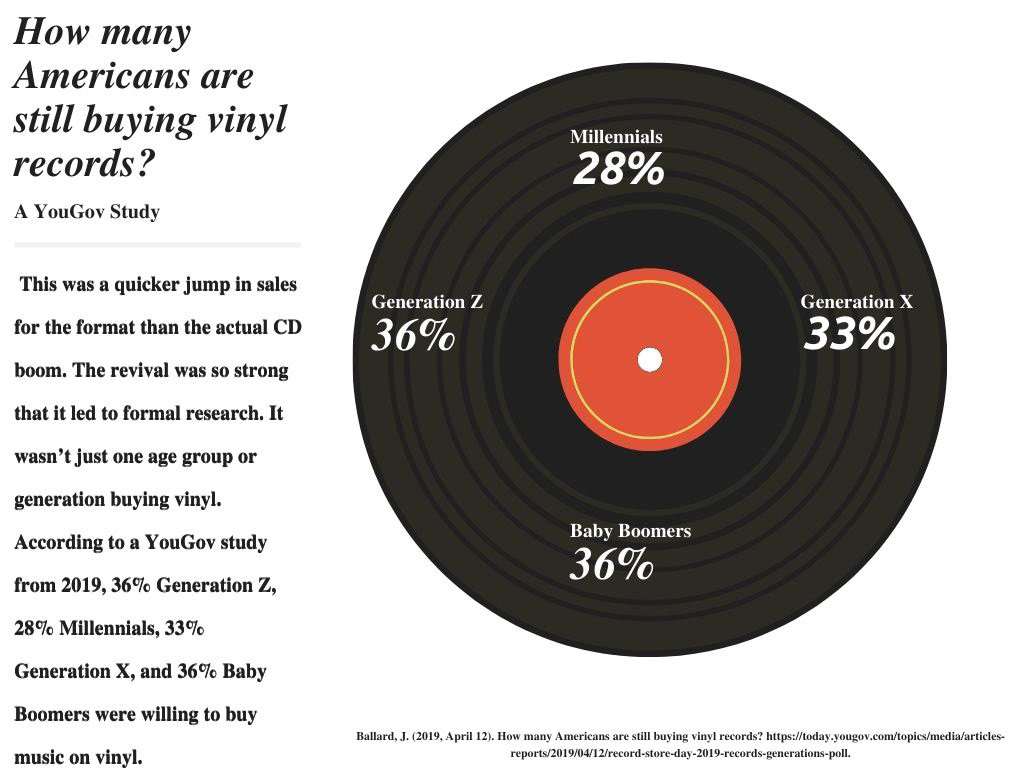
The compact disc had cemented themselves and swamped the market. Music was fully digital. iTunes had been introduced in 2001. The application is multiple functions. The original purpose of the application was to buy and download albums, rip their CDs, and organize and archive their collections. This blossom music streaming, which saw a huge ecstatic upsurge rise on the back end of the 2000s and 2010s decades. While music streaming was taking shape, an unexpected resurgence in vinyl was rumbling. Around 2006, vinyl sales amplified to 30% in the United States. (Schauman, S., Heinonen, K., & Holmlund, M.) This was a quicker jump in sales for the format than the actual CD boom. The revival was so strong that it led to formal research. It wasn’t just one age group or generation buying vinyl. According to a YouGov study from 2019, 36% Generation Z, 28% Millennials, 33% Generation X, and 36% Baby Boomers were willing to buy music on vinyl. In the same study, they found in general, Americans are almost 50% to buy an album on CD or vinyl. And 72% of the same group would buy their favorite musical artists' physical copy and support them. The greatest percentage was 76%, which served for people are willing to see their musical artist live (Ballard, J.) Now that physical music listener was back, what invoked those people to rebuy? Well, those of the newer demographic are obsessed with material possessions.
Like I said earlier in this paper, MP are a source of gratification. For the earlier generation, collecting records, again, we're beginning to reawaken their younger years. In other words, this means the older generations found this revival was a sentimentality of nostalgia. Which is a great thing because nostalgia allows for a reimagination of their past and a familial bond.
With this new era of wax wonders and vinyl junkies, Criminal Records in Atlanta created Record Store Day (Harvey, E.) Which is an annual event every third Saturday of April. At this event, select stores across the nation receive and sell select reissues. Many of these reissues are previous albums but have a special edition to them. The possibilities of what kind of reissue it will be are endless. It could be a different color wax, lyrical booklets, unreleased tracks, and so much more. The day is like a record holiday. Many stores have people waiting in long lines, concerts, autographs, and meet and greets. The day brings all walks of life. It is a beautiful thing to see that physical music is alive and well.
How to Start a Collection of Your Own
There are many ways to start a collection. It is certainly easy to make your way, which is fine, but knows that some products will be better for your records in the long term. Record collecting is really fun once you get started; however, the start can have some expensive obstacles. Once you get established with your record player and accessories, then you can go as inexpensive or luxurious with your album selection.
The first thing I would recommend is buying your record player. Now, that there is a brand that you should avoid whenever possible. That brand is called “Crosley Radio.” They are deceptive with their vintage design and economical price range. The reason this brand is reviled in the community is that their stylus is cheaply made plastic. As well as the tracking force of the tonearm is too heavy and cannot be adjusted. (Matthew.) Instead of purchasing that brand, I would suggest the mid-range belt drive Audio-Technica AT-LP120. For the reasons: heavy, built tough, an adjustable tonearm and tracking force, a pitch variation, plays 33, 45, and 78 records, and lastly, this turntable has a built-in preamp, which is nice since it is one less thing you have to buy. After obtaining this turntable, you would need speakers to hear your records. The best speakers that pair with the AT-LP120 are the Audioengine A5 Plus. As you move forward, you may want to change your setup’s dustcover, mat, stylus, and cartridge. But that is totally optional. Although, you should change your stylus every 800 hours of listening. Dust and particles can drag onto your stylus easily. Dust is the arch-nemesis to vinyl. Of course, there are a bunch of different and numerous types of turntables and speakers to choose from, but I believe if you are eager to listen to records as soon as possible, this would be the quickest yet efficient way to start. It is best to get antiquated with your setup, in case you are asked or looking for replacement parts.
Next, you should go to the local record store. Most record stores are typically found in malls today. When there, communicate with the staff. Ask for recommendations, what is currently being spun, where your favorite band’s section is located. Networking thrives. Check out the bargain bins, you will be surprised how often you will find your favorite artists’ underrated album. When expecting the discs, look for scratches and gashes. Conditions vary, from disc to disc. The proper terms for conditions are Mint (M), Near Mint (NM or M-), Very Good Plus (VG+), Very Good (VG), Good (G), Fair (F), and Poor (P). Most shops have the conditions listed next to the price tag. The condition of the jacket is occasionally obvious.
Following making some healthy trips to the record store, it is time to invest in storage. Again, there are various storage units, but these are my suggestions. IKEA`s Kallax series is easy to assemble, the perfect length for all record jackets, has a color variant, and interchangeable. Just remember to keep your records up and never stack them! You could also use milk crates if you could find them behind a grocery store’s lot.
Having a collection is a two double-edged sword. One side is listening. The other side is upkeep. Maintenance and cleaning of your records are an essential task. Dust climbs onto the grooves often, by doing this task will keep the life of your records longer. A simple anti-static brush is good to use before every spin. Do not wash your records with soap and water, use a special solution, that is found and sold at a record store.
The last thing you should consider is creating a Discogs account. Discogs is a website and crowdsourced database for your collection. You can catalog your albums by artist, title, year, date added, record label, and catalog #. By scanning any barcode on the album or looking up the catalog # and find any record possible. Several albums even have audio samples, which helps you listen before buying. Discogs even has a mobile application. Discogs let you to create wish lists, buy, and sell albums directly. You always can see the value of your collection according to the marketplace. In the app, there is a world map called “VinylHub.” Which tells you all the records stores across the universe. It is like Google Maps for record stores.
After you have followed these steps, you are all set for becoming an audiophile. Happy collecting!
Conclusion
Vinyl is a prevailing format and is here to stay. The stronghold of current vinyl sales is astronomical each year. Compact discs still do exist, but the sale to resale value is pennies. Big box chains have even part with CDs, in place for pricey reissues. It is best to stay away from big box chains because they hinder local tourism and record stores. Vinyl will continue to thrive for the future, as long as the future generations believe and cherish material possessions, individualism, and vintage goods. I believe the recent vinyl resurgence will boom a renewed interest in auditory history. This renewed interest in auditory history will hopefully lead to revolutionary creations that arise from Scott’s cylinders, Edison’s discs, and Berliner’s discs.
References
Ballard, J. (2019). 31% of Americans are willing to pay for music on vinyl records. YouGov. https://today.yougov.com/topics/media/articles-reports/2019/04/12/record-store-day-2019-records-generations-poll
Blevins, J. (2017). In 1988, McDonald's released a maddening "$1,000,000 MENU SONG". https://news.avclub.com/in-1988-mcdonald-s-released-a-maddening-1-000-000-me-1798247206
DeGraaf, L. (1995). Confronting the mass market: Thomas Edison and the entertainment phonograph. Business and Economic History, 88-96.
Feaster, P. (2012). The dawn of recorded sound in America. From https://www.theatlantic.com/technology/archive/2012/01/the-dawn-of-recorded-sound-in-america/251743/
Giles, J. (2019). How Billy Joel’s “52nd Street” Became the First Compact Disc Released. Ultimate Classic Rock. https://ultimateclassicrock.com/the-first-compact-disc-released/
Gitelman, L. (1999). Scripts, grooves, and writing machines: Representing technology in the Edison era. Stanford University Press.Harvey, E. (2017). Siding with vinyl: Record Store Day and the branding of independent music. International Journal of Cultural Studies, 20(6), 585-602.
Hosokawa, S., & Matsuoka, H. (2004). Vinyl Record Collecting. Hosokawa, S., & Matsuoka, H. (2004). Vinyl Record Collecting. Fanning the flames: Fans and consumer culture in contemporary Japan
Levins, H. (2009). A Photo History of RCA's Golden Years in Camden http://historiccamdencounty.com/ccnews138.shtml
Matthew. (2020). Crosley Turntables Reviews: Why You Shouldn’t Buy a Crosley Turntable. Song Lyrics & Facts. shorturl.at/fxEX9
Müller, A., & Schönhart, S. Compact disk. http://cs-exhibitions.uni-klu.ac.at/index.php?id=304.
National Park Service. Origins of sound recording: Edison's path to the phonograph. (n.d.). From https://www.nps.gov/edis/learn/historyculture/origins-of-sound-recording-edisons-path-to-the-phonograph.htm
Plasketes, G. (1992). Romancing the record: The vinyl de-evolution and subcultural evolution. Journal of Popular Culture, 26(1), 109.
Osborne, R. (2016). Vinyl: A history of the analogue record. Routledge.
Santos, H. C., Varnum, M. E., & Grossmann, I. (2017). Global increases in individualism. Psychological science, 28(9), 1228-1239.
Schauman, S., Heinonen, K., & Holmlund, M. (2020). Crafting customer insight: What we can learn from the revival of the vinyl record. Business Horizons.
Sinclair, G., & Tinson, J. (2017). Psychological ownership and music streaming consumption. Journal of Business Research, 71, 1-9.
Smart, J. R. (1980). Emile Berliner and Nineteenth-Century Disc Recordings. In The Quarterly Journal of the Library of Congress (Vol. 37, No. 3/4, pp. 422-440). Library of Congress.
The Vintage Record. (2014). American History Now. http://americanhistorynow.org/2014/01/27/the-history-of-vinyl/